The guitar is a fascinating instrument that has captured the hearts and minds of those who hear it ever since instruments of its like were first created back in the 12th century (though they weren’t called guitars back then). There are many different types of guitars, but one of the most popular today is the electric guitar. Electric guitars are interesting because not only are they very different in both design and sound to previous, more traditional, guitars; they are also a relatively recent development in music.
Before electric guitars were created, the most common form of guitar was the acoustic guitar. Acoustic guitars feature a hollow body that acts as an amplifier for the instrument, taking the sound from the strings and making it louder from the resonance in the body. While electric guitars often are the first type of guitar that comes to mind nowadays, acoustic guitars are very much still in use. Here is an example of classical acoustic guitar music: the song “Malaguena” by the Cuban composer Ernesto Lecuona in 1933, performed by Michael Lucarelli.
Today, Electric guitars are primarily loved for their signature sound; but the original goal when creating them was actually to make the more traditional acoustic guitar louder. As concerts grew in size, musicians simply needed louder instruments in order to be heard. In the 19th century guitar makers began to use steel strings for their guitars in order to increase the volume of the instruments, but as the demand for even louder guitars grew it was realized that a different method was needed.
The technology called a pickup that would one-day form the basis for the modern electric guitar was invented on November 19th, 1924 by Lloyd Loar who realized that you could use a magnet to transfer the vibrations from guitar strings into electrical systems. In 1931, when a pickup was attached to an aluminium guitar that was termed “The Frying Pan” what is today considered the first electric guitar was created. Early electric guitar designs attempted to attach pickups to current acoustic designs, but the vibrations created in the hollow body of the instrument caused a feedback with the vibrations from the strings of the instrument that muddled the sound. With this discovery they realized that when looking to make an electric guitar a solid body was actually better because it removed the feedback (consequently, with a solid body guitar shape doesn’t matter leading to the many flamboyant designs often seen in rock and roll).
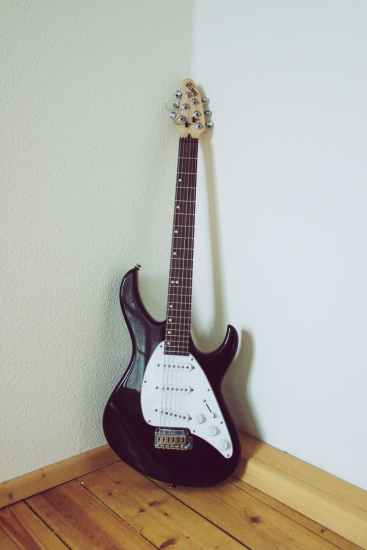
While created for its volume, people soon came to love the electric guitars signature sound. Electric guitars have different musical properties than their more traditional counterparts and are capable of different techniques. While acoustic guitars have a warmer more resonant timbre, electric guitars are often loved for their crisp and clear sound. Another musical difference between the two instruments is that electric guitars are capable of achieving far larger downward leaps between notes (going from one note to a lower note) with a technique known as “dive bombing” to force the lowest note of an electric guitar even lower. The electric guitar was initially embraced by country, blues, and jazz musicians but it was in the 1950’s when rock and roll came around that the electric guitar truly found its home and never looked back. Here is an example of an electronic guitar solo from the youtube channel Bab V.
Personally, I think both the classical acoustic guitar and the electric guitar have great sound qualities to them. I love the classical acoustic guitar when I want to listen to something relaxing, but I much prefer the sound of the electric guitar when I want to listen to something more energetic. When I was a kid I actually used to play the classical acoustic guitar and I wish I had stuck with it; in fact to this day, while I overall prefer listening to the electric guitar more I think that the music of the classical acoustic guitar sounds more fun to play.
Sources:

 Explorations in Music
Hi Cory,
I enjoyed reading your post on the transformation from the acoustic guitar to the electric guitar! I was not aware of how the electric guitar was invented so early in the 20th century. Thinking about it now that time makes sense considering Elvis started in the 50’s.
I also completely agree with your statement of how acoustic guitars tend to be more relaxing, while electric guitars are more energetic. From the music I have listened to, acoustic guitars are typically associated with slower portions of a song and the electric guitar is of course known for fast solos. In fact, it is pretty interesting how the electric guitar seems to be pushed to the limit in terms of speed in some genres today, even to the point that there now exists a sub-genre called “Speed Metal.”
Great post!
LikeLike